
The Evolution of API Design: What’s Changed by 2026?
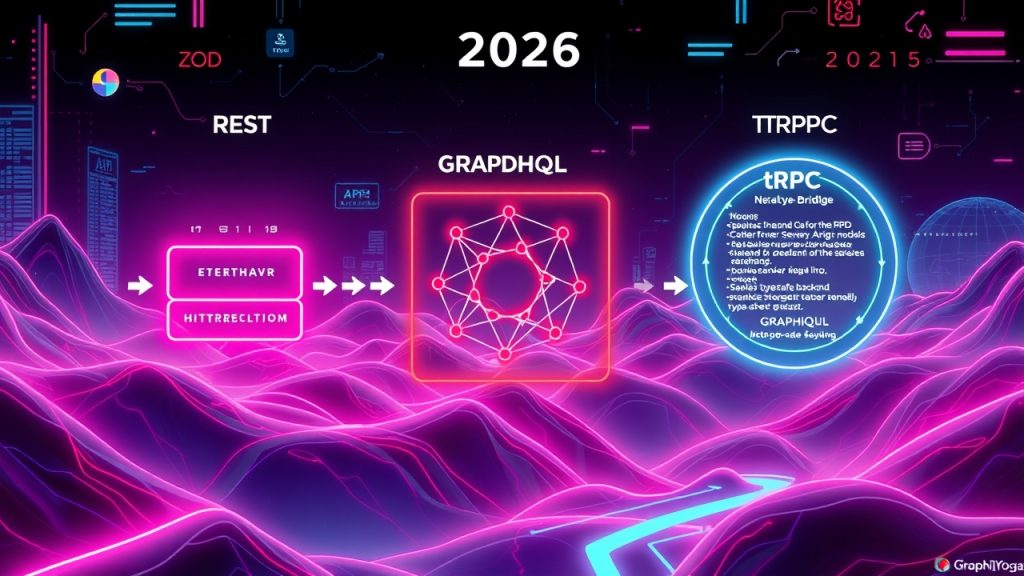
API design has undergone significant transformation over the past few years, driven by the demand for faster, more scalable, and developer-friendly architectures. By 2026, the focus has shifted from traditional RESTful APIs to more flexible and performance-oriented solutions like GraphQL and tRPC. Developers now prioritize efficiency, real-time capabilities, and seamless integration with modern frontend frameworks. The rise of tools like Zod for validation, Hono for lightweight server creation, and GraphQL Yoga 5 for enhanced GraphQL server management reflects this shift. Understanding these changes is crucial for selecting the right API paradigm that aligns with your project’s goals and future scalability.
REST APIs: The Tried-and-True Workhorse
REST (Representational State Transfer) remains a cornerstone of API design, especially for applications that require simplicity, caching, and broad compatibility. In 2026, REST APIs continue to be the go-to choice for public APIs, microservices, and applications where standardized communication is essential. REST leverages HTTP methods (GET, POST, PUT, DELETE) to perform CRUD operations, making it intuitive and widely supported. However, REST has its limitations, particularly in over-fetching and under-fetching data, which can impact performance and bandwidth usage. Despite these challenges, REST’s maturity and tooling ecosystem ensure it stays relevant, especially for projects where stability and ease of use are paramount.
- REST APIs follow a stateless client-server model, ensuring scalability and reliability.
- They are ideal for public APIs, microservices, and applications requiring broad compatibility across platforms and devices.
- Performance can be optimized with caching mechanisms like HTTP caching headers and CDNs.
- REST APIs often face challenges with over-fetching or under-fetching data, leading to inefficiencies.
- Modern tooling like OpenAPI/Swagger helps document and validate REST APIs efficiently.
GraphQL: The Flexible Powerhouse for Modern Frontends
GraphQL has revolutionized API design by enabling clients to request exactly the data they need, reducing over-fetching and under-fetching issues. In 2026, GraphQL’s flexibility makes it the preferred choice for frontend-heavy applications, particularly those built with React, Vue, or Svelte. GraphQL’s schema-first approach allows developers to define a single endpoint that serves multiple data requirements, simplifying frontend development and improving performance. Tools like GraphQL Yoga 5 have further streamlined the process by offering enhanced server capabilities, built-in subscriptions for real-time data, and improved developer experience. However, GraphQL can introduce complexity in caching and requires careful schema design to avoid performance bottlenecks.
- GraphQL allows clients to specify the exact data they need, reducing unnecessary data transfers.
- It excels in frontend-heavy applications where reducing over-fetching improves performance and user experience.
- GraphQL’s real-time capabilities via subscriptions make it ideal for applications requiring live updates, such as dashboards or chat apps.
- Caching in GraphQL can be challenging compared to REST, often requiring additional tools like Apollo Client or Relay.
- Schema design is critical; poorly designed schemas can lead to performance issues and maintenance challenges.
tRPC: The Type-Safe Revolution for Full-Stack TypeScript Applications
tRPC (TypeScript Remote Procedure Call) has emerged as a game-changer for full-stack TypeScript applications, particularly those using Next.js, Remix, or Astro. By leveraging TypeScript’s type system, tRPC enables end-to-end type safety, eliminating the need for manual API documentation and reducing runtime errors. In 2026, tRPC’s seamless integration with modern frontend frameworks and its ability to generate fully typed APIs from the server have made it a favorite among TypeScript developers. Unlike REST or GraphQL, tRPC abstracts away the HTTP layer, focusing on procedure calls that feel like local function calls. This approach significantly boosts developer productivity and reduces boilerplate code, though it may lack the broader ecosystem and tooling depth of REST or GraphQL.
- tRPC provides end-to-end type safety, reducing runtime errors and improving developer experience.
- It integrates seamlessly with full-stack TypeScript frameworks like Next.js, Remix, and Astro.
- tRPC abstracts the HTTP layer, allowing developers to write APIs as if they were local function calls.
- The ecosystem is smaller compared to REST or GraphQL, with fewer third-party tools and integrations.
- Best suited for internal APIs or applications where type safety is a priority.
Performance Comparison: REST vs. GraphQL vs. tRPC
Performance is a critical factor when choosing an API paradigm. REST APIs excel in scenarios where caching and standardized responses are key, thanks to HTTP caching mechanisms and CDNs. GraphQL, while flexible, can introduce performance overhead due to query complexity and the need for server-side query optimization. However, tools like GraphQL Yoga 5 and advanced query planners help mitigate these issues. tRPC, on the other hand, offers superior performance in full-stack TypeScript applications by eliminating the need for manual API calls and reducing serialization overhead. Benchmarking in 2026 shows that tRPC often outperforms REST and GraphQL in applications where type safety and developer productivity are prioritized, though GraphQL remains unmatched for real-time and data-intensive applications.
- REST APIs benefit from HTTP caching, making them ideal for read-heavy applications with predictable data structures.
- GraphQL’s performance depends on query complexity; poorly optimized queries can lead to server strain and slower responses.
- tRPC eliminates serialization overhead and manual API calls, resulting in faster execution in TypeScript applications.
- GraphQL Yoga 5 and similar tools help optimize GraphQL performance by improving query planning and caching strategies.
- The choice between REST, GraphQL, and tRPC should align with your application’s specific performance and scalability requirements.
Developer Experience and Tooling in 2026
Developer experience (DX) has become a top priority in API design, with tools playing a pivotal role in shaping the workflow. In 2026, REST APIs benefit from mature tooling like OpenAPI/Swagger for documentation, Postman for testing, and various ORMs for database interactions. GraphQL developers enjoy enhanced tooling with GraphQL Yoga 5, Apollo Client, and Relay for state management and real-time data. tRPC shines in TypeScript-centric environments, with seamless integration into frameworks like Next.js and Remix, along with type generation tools like Zod for runtime validation. The choice of tools often dictates the API paradigm, with tRPC offering the simplest setup for TypeScript projects, GraphQL providing unparalleled flexibility for frontend developers, and REST remaining the most universally supported option.
- REST tools: OpenAPI/Swagger for documentation, Postman for testing, ORMs for database interactions.
- GraphQL tools: GraphQL Yoga 5 for server management, Apollo Client for state management, Relay for real-time data.
- tRPC tools: TypeScript-first frameworks like Next.js and Remix, Zod for runtime validation, end-to-end type generation.
- The tooling ecosystem significantly impacts developer productivity and can influence the API paradigm choice.
- Modern tooling like Hono enables lightweight server creation, simplifying the development of REST and GraphQL APIs.
When to Use REST, GraphQL, or tRPC in 2026
Selecting the right API paradigm depends on your project’s requirements, team expertise, and long-term scalability goals. REST is the safest choice for public APIs, microservices, and applications where simplicity and broad compatibility are essential. GraphQL is ideal for frontend-heavy applications, real-time features, and projects where reducing over-fetching is a priority. tRPC is the best fit for full-stack TypeScript applications, particularly those using Next.js or Remix, where type safety and developer productivity are critical. Hybrid approaches, such as using GraphQL for public APIs and tRPC for internal APIs, are also gaining traction in 2026, allowing teams to leverage the strengths of each paradigm.
- Use REST for public APIs, microservices, and applications requiring broad compatibility and caching benefits.
- Choose GraphQL for frontend-heavy apps, real-time features, and projects where reducing over-fetching improves performance.
- Opt for tRPC in full-stack TypeScript applications, especially with frameworks like Next.js or Remix, to maximize type safety and developer experience.
- Consider hybrid approaches, such as combining GraphQL for public APIs with tRPC for internal APIs, to balance flexibility and type safety.
- Evaluate your project’s data requirements, team expertise, and scalability needs before committing to a single API paradigm.
Future-Proofing Your API Architecture
As we look beyond 2026, the API landscape will continue to evolve, with trends like AI-driven API generation, edge computing, and enhanced real-time capabilities shaping the future. To future-proof your API architecture, consider adopting a modular approach that allows for easy integration of new paradigms and tools. Stay updated with advancements in GraphQL Yoga 5, tRPC, and emerging technologies like WebAssembly for API performance optimization. Additionally, prioritize API documentation, testing, and monitoring to ensure long-term maintainability and scalability. By staying agile and leveraging modern tooling, you can build APIs that not only meet today’s demands but also adapt to tomorrow’s challenges.
- Adopt a modular API architecture to easily integrate new paradigms and tools as they emerge.
- Stay updated with advancements in tools like GraphQL Yoga 5, tRPC, and emerging technologies like WebAssembly.
- Prioritize API documentation, testing, and monitoring to ensure long-term maintainability and scalability.
- Leverage edge computing and real-time capabilities to enhance API performance and user experience.
- Future-proofing requires balancing innovation with stability, ensuring your API architecture remains adaptable and scalable.
Conclusion: Making the Right Choice for Your Project
API design in 2026 offers more options than ever, each with its own strengths and trade-offs. REST remains a reliable choice for its simplicity and broad compatibility, while GraphQL provides unmatched flexibility for frontend developers and real-time applications. tRPC, with its type-safe and developer-friendly approach, is revolutionizing full-stack TypeScript development. The key to making the right choice lies in understanding your project’s unique requirements, evaluating the performance and scalability needs, and leveraging modern tooling to streamline development. Whether you opt for REST, GraphQL, tRPC, or a hybrid approach, aligning your API design with your long-term goals will ensure a robust, scalable, and future-proof architecture.