
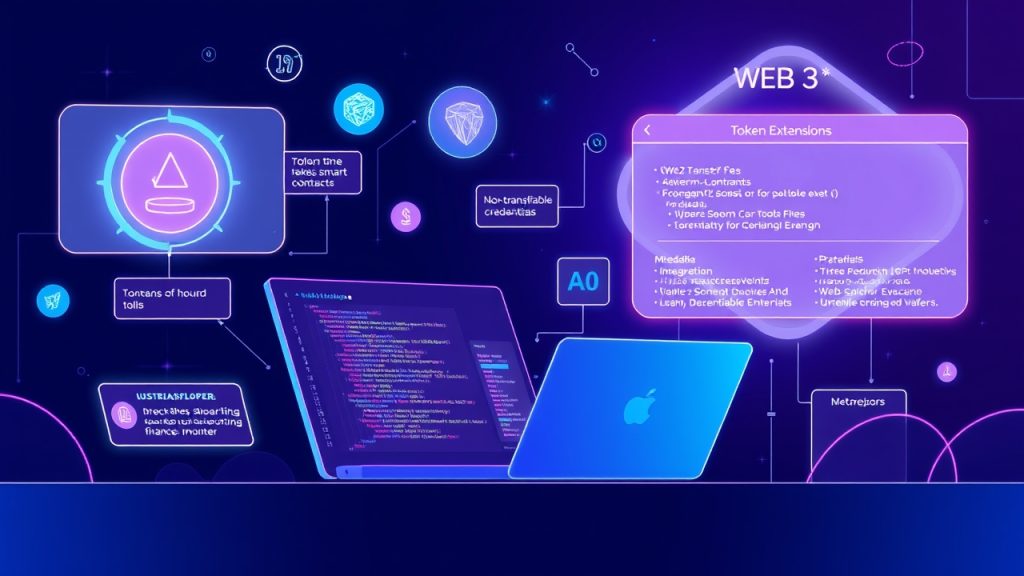
Why Solana Token Extensions Are a Game-Changer for Web2 Developers
Solana’s Token Extensions, specifically the Token-2022 program, represent a paradigm shift in blockchain development. Traditionally, Web2 developers faced steep learning curves when transitioning to Web3 due to the need for backend infrastructure, complex smart contract logic, and security vulnerabilities. Token-2022 changes this by enabling developers to implement advanced token features directly on-chain, eliminating the need for external APIs or middleware. This reduces development time, lowers costs, and enhances security, making it an ideal solution for Web2 developers looking to explore decentralized applications (dApps) without the overhead of traditional blockchain development.
- Token-2022 allows developers to embed transfer fees directly into tokens, enabling revenue-sharing models without third-party integrations.
- Non-transferable tokens (NFTs) can be created to represent credentials, memberships, or access passes, restricting ownership transfer to enforce compliance.
- Metadata integration is streamlined, allowing developers to attach rich data (e.g., images, descriptions) to tokens without relying on external storage.
- Decimal precision and arithmetic are handled protocol-level, ensuring accurate calculations for fractional token amounts without custom code.
- Security is enforced at the protocol level, reducing risks of exploits like reentrancy attacks or unauthorized minting.
Key Features of Token-2022 That Simplify On-Chain Development
Token-2022 introduces several features that bridge the gap between Web2 and Web3 development. Unlike the original Token Program, Token-2022 supports extensible token standards, meaning developers can customize tokens to meet specific use cases without writing additional smart contracts. For example, transfer fees can be configured to deducted automatically during transactions, while non-transferable tokens can enforce ownership constraints. Additionally, the program supports advanced metadata standards (e.g., Metaplex’s Token Metadata Standard), making it easier to attach visual and descriptive data to tokens.
- Transfer Fees: Automatically deduct a percentage or fixed fee from each transaction, enabling sustainable revenue models for creators and platforms.
- Non-Transferable Tokens: Restrict token transferability to enforce compliance, such as membership passes or access credentials.
- Metadata Extensions: Attach JSON-based metadata to tokens, including images, descriptions, and attributes, without relying on external databases.
- Decimal Precision: Handle fractional token amounts with protocol-level arithmetic, ensuring accuracy for financial applications.
- Programmable Permissions: Define who can mint, burn, or freeze tokens, adding layers of control for token owners.
Step-by-Step: Building a Custom Token with Transfer Fees
Creating a token with built-in transfer fees is straightforward with Token-2022. Start by initializing the token with the TransferFee extension enabled. Specify the transfer fee percentage (e.g., 2%) and the maximum fee amount. When users transfer tokens, the fee is automatically deducted and sent to a designated account, such as a creator’s wallet or a platform treasury. This eliminates the need for off-chain calculations or manual fee distribution, reducing complexity and potential errors. Below is a simplified example using the Solana CLI and JavaScript SDK.
- Initialize the token with the TransferFee extension using the Solana CLI or JavaScript SDK.
- Specify the transfer fee percentage (e.g., 2%) and the maximum fee amount in basis points (e.g., 10000 = 100%).
- Deploy the token on the Solana devnet for testing, then switch to mainnet-beta for production.
- Integrate the token into your dApp or platform, ensuring transactions automatically apply the transfer fee.
- Monitor fee distribution using blockchain explorers like Solscan or SolanaFM.
Creating Non-Transferable Tokens for Credentials and Access Control
Non-transferable tokens (NFTs) are ideal for representing credentials, memberships, or access rights. With Token-2022, you can enforce non-transferability by disabling the transfer instruction for the token. This ensures that tokens cannot be sold, traded, or transferred once issued, maintaining the integrity of the credential system. For example, a university could issue non-transferable NFTs to students as digital diplomas, while a co-working space might use them for membership passes. The protocol-level enforcement ensures compliance without requiring backend checks.
- Initialize a non-transferable token by disabling the transfer instruction during creation.
- Attach metadata (e.g., name, image, description) to the token using the Metaplex Token Metadata Standard.
- Issue tokens to users via a simple transaction, ensuring they cannot be transferred or sold.
- Use the tokens for access control by verifying ownership on-chain in your dApp.
- Audit token transfers using blockchain explorers to ensure non-transferability is enforced.
Integrating Metadata for Rich Token Representations
Metadata adds context to tokens, making them more than just numbers on a blockchain. Token-2022 supports the Metaplex Token Metadata Standard, which allows developers to attach JSON metadata to tokens. This metadata can include images, descriptions, attributes, and even links to external resources. For example, a gaming token could include metadata for in-game items, while a loyalty token could include brand logos and redemption details. The metadata is stored on-chain, ensuring permanence and immutability.
- Use the Metaplex Token Metadata Standard to attach metadata to your token.
- Include fields like name, symbol, description, image URI, and attributes in the metadata JSON.
- Store metadata on-chain or reference off-chain storage (e.g., Arweave, IPFS) using URIs.
- Update metadata as needed by re-submitting the metadata JSON and updating the token’s metadata account.
- Leverage metadata in your dApp to display rich token information to users.
Handling Decimal Precision and Arithmetic Protocol-Level
Decimal precision is critical for financial applications, where fractional token amounts must be handled accurately. Token-2022 simplifies this by enforcing decimal precision at the protocol level. When creating a token, you specify the number of decimals (e.g., 6 for USDC-like tokens), and the blockchain automatically handles the conversion between integer and fractional amounts. This eliminates the need for custom arithmetic logic in smart contracts, reducing complexity and potential bugs. For example, a token with 6 decimals can represent values like 1.000000 or 0.000001 without additional code.
- Specify the number of decimals (e.g., 6) when creating the token to handle fractional amounts.
- Use the token’s mint account to query decimals for accurate display in your dApp.
- Perform arithmetic operations (e.g., transfers, swaps) using integer amounts scaled to the token’s decimals.
- Leverage Solana’s built-in math libraries for precise calculations in JavaScript or Rust SDKs.
- Avoid manual decimal conversion to prevent rounding errors in financial applications.
Security Considerations: Avoiding Common Pitfalls
While Token-2022 reduces many security risks by handling logic at the protocol level, developers must still be aware of potential pitfalls. For example, improper fee configurations could lead to excessive deductions or unintended revenue loss. Similarly, non-transferable tokens must be carefully implemented to avoid accidentally enabling transfers. Always test tokens on devnet before deploying to mainnet, and use tools like Solana’s Anchor framework to audit your code for vulnerabilities. Additionally, ensure that token permissions (e.g., mint, freeze) are restricted to authorized accounts to prevent unauthorized changes.
- Test tokens thoroughly on devnet before deploying to mainnet to catch configuration errors.
- Use the Anchor framework for Rust-based smart contracts to ensure code safety and security.
- Restrict minting and freezing permissions to authorized accounts only.
- Monitor token transfers and fee distributions using blockchain explorers to detect anomalies.
- Follow Solana’s best practices for token creation, such as using secure randomness for mint keys.
Use Cases: Real-World Applications of Token-2022
Token-2022’s flexibility opens doors to innovative use cases across industries. In gaming, tokens can represent in-game assets with built-in royalties, while in loyalty programs, tokens can include transfer fees to fund platform operations. Education institutions can issue non-transferable credentials as NFTs, and decentralized autonomous organizations (DAOs) can use programmable tokens for governance. The ability to customize tokens without backend overhead makes Token-2022 a powerful tool for developers and businesses alike.
- Gaming: Create in-game assets with transfer fees to fund developers and platforms.
- Loyalty Programs: Issue tokens with transfer fees to sustain platform economics.
- Education: Issue non-transferable NFTs as digital diplomas or certificates.
- DAOs: Use programmable tokens for governance and voting rights.
- Supply Chain: Track goods using tokens with embedded metadata and permissions.
Getting Started: Tools and Resources for Developers
To start building with Token-2022, familiarize yourself with Solana’s development tools and documentation. The Solana CLI and JavaScript SDK are essential for token creation and management, while libraries like `@solana/spl-token` simplify interactions with the Token-2022 program. For metadata integration, Metaplex’s tools and standards provide a robust framework. Additionally, explore tutorials and example projects on GitHub to accelerate your learning curve. Resources like the Solana Docs, Metaplex’s guides, and community forums (e.g., Solana Stack Exchange) are invaluable for troubleshooting and best practices.
- Install the Solana CLI and configure your development environment.
- Use the `@solana/spl-token` library to interact with Token-2022 programmatically.
- Explore Metaplex’s Token Metadata Standard for attaching rich data to tokens.
- Check out GitHub repositories with Token-2022 examples for hands-on learning.
- Join Solana’s developer community on Discord or Stack Exchange for support.
Future of Token Extensions: What’s Next for Token-2022
Token-2022 is just the beginning of Solana’s vision for extensible tokens. Future updates may include additional extensions for features like time-locked tokens, dynamic fees, or interoperability with other blockchains. As the ecosystem matures, we can expect more tools and frameworks to simplify token customization, making it even easier for Web2 developers to transition to Web3. With ongoing innovation, Token-2022 is poised to become a cornerstone of on-chain economic engineering, unlocking new possibilities for decentralized applications and digital economies.
- Time-locked tokens: Enforce token locks for vesting or staking use cases.
- Dynamic fees: Adjust transfer fees based on transaction volume or network conditions.
- Cross-chain interoperability: Extend token functionality to other blockchains like Ethereum or Polygon.
- Enhanced metadata: Support for more complex metadata structures (e.g., 3D models, interactive assets).
- Improved tooling: More IDE plugins, SDKs, and templates for rapid token development.