
Why Multi-Agent AI is the Future of Software Engineering
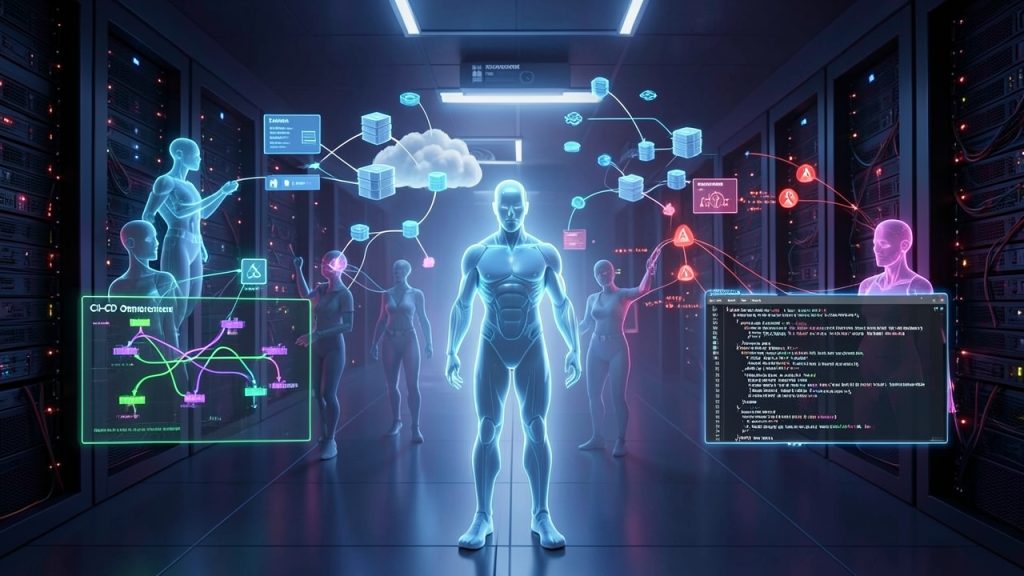
Traditional DevOps workflows rely heavily on human oversight, manual scripting, and rigid automation tools that often struggle to adapt to dynamic software development environments. Multi-agent AI systems introduce a paradigm shift by distributing intelligence across specialized agents, each designed to handle specific tasks such as CI/CD optimization, automated testing, deployment management, and security compliance. Unlike single-agent models, these systems enable parallel processing, context-aware decision-making, and autonomous workflow execution, reducing bottlenecks and accelerating software delivery cycles. By mimicking human team structures—where each member has a distinct role—multi-agent AI teams enhance scalability, fault tolerance, and precision in complex DevOps pipelines.
Core Components of a Multi-Agent AI DevOps Workflow
- Lead Agent: The orchestrator that delegates tasks to specialized agents, manages inter-agent communication, and ensures workflow coherence. It acts as the central hub for decision-making and progress tracking.
- CI/CD Optimizer Agent: A specialized agent that analyzes pipelines, identifies inefficiencies, and suggests or implements optimizations such as parallel job execution, caching strategies, or trigger-based workflows to reduce build times.
- Testing Specialist Agent: Automates test case generation, execution, and analysis, integrating with frameworks like JUnit, pytest, or Selenium. It prioritizes test coverage, identifies flaky tests, and suggests improvements to enhance software reliability.
- Deployment Manager Agent: Handles environment provisioning, rollout strategies (e.g., blue-green, canary), and rollback mechanisms. It ensures zero-downtime deployments while adhering to compliance and security policies.
- Security & Compliance Agent: Monitors for vulnerabilities, enforces security policies, and ensures compliance with standards like OWASP, GDPR, or SOC2. It integrates with tools like Snyk, Checkov, or Aqua Security to scan code, containers, and infrastructure.
- Monitoring & Feedback Agent: Collects metrics, logs, and performance data from tools like Prometheus, Grafana, or Datadog. It provides actionable insights to other agents and human teams for continuous improvement.
Designing Specialized Agents for DevOps Workflows
Building effective multi-agent AI systems starts with defining clear roles for each agent based on the DevOps lifecycle phases: plan, code, build, test, release, deploy, operate, and monitor. For instance, a CI/CD Optimizer Agent might use reinforcement learning to analyze historical pipeline data and recommend optimizations, while a Testing Specialist Agent could employ generative AI to create edge-case test scenarios based on code changes. Each agent should have access to a curated set of tools and APIs, with strict allowlists to prevent unauthorized actions. Context isolation is critical—agents should operate in sandboxes to avoid unintended side effects. Additionally, agents should support human-in-the-loop approvals for high-risk operations, such as production deployments.
Integration Patterns with DevOps Tools
- GitHub Integration: Use GitHub Actions or the GitHub API to trigger agent workflows on pull requests, commits, or issue updates. The CI/CD Optimizer Agent can analyze GitHub Actions workflow files to suggest optimizations, while the Testing Specialist Agent can run tests directly in GitHub Actions and post results as comments on pull requests.
- Jenkins Automation: Deploy agents as Jenkins plugins or use the Jenkins API to extend pipeline capabilities. The Deployment Manager Agent can interact with Jenkins to orchestrate complex deployment pipelines, including multi-stage approvals and rollback procedures.
- Cloud Providers (AWS, Azure, GCP): Integrate agents with cloud-native tools like AWS CodePipeline, Azure DevOps, or Google Cloud Build. The Security Agent can scan infrastructure-as-code (IaC) templates (e.g., Terraform, CloudFormation) for misconfigurations, while the Monitoring Agent can push metrics to cloud-based observability platforms.
- Container Orchestration (Kubernetes): Use agents to manage Kubernetes manifests, Helm charts, and custom resource definitions (CRDs). The Deployment Manager Agent can handle pod scaling, canary deployments, and service mesh configurations (e.g., Istio, Linkerd).
- Infrastructure as Code (IaC): Agents can validate and optimize Terraform, Ansible, or Pulumi scripts, ensuring that infrastructure changes are consistent, secure, and efficient. The Security Agent can also scan IaC for compliance violations.
Security and Governance in Multi-Agent AI Workflows
Security is paramount in AI-driven DevOps workflows, where autonomous agents interact with critical systems and sensitive data. To mitigate risks, implement a zero-trust model with tool allowlists that restrict agent actions to pre-approved tools and APIs. Use OpenID Connect (OIDC) for authentication, allowing agents to securely interact with cloud platforms and SaaS tools without exposing long-lived credentials. Additionally, enforce approval-gated workflows for high-risk operations, such as production deployments or infrastructure changes. The Security Agent should continuously monitor for anomalies, such as unauthorized tool usage or unexpected agent behavior, and trigger alerts or automatic rollbacks when necessary. Regular audits and penetration testing of agent systems are essential to identify and remediate vulnerabilities.
Real-World Use Cases and Success Stories
Multi-agent AI systems are already transforming DevOps in industries ranging from fintech to healthcare. For example, a fintech company deployed a CI/CD Optimizer Agent that reduced build times by 40% by dynamically adjusting parallelism and caching strategies. A healthcare SaaS provider used a Testing Specialist Agent to generate 30% more test cases, improving test coverage from 85% to 98% and reducing production defects by 25%. In another case, an e-commerce platform integrated a Deployment Manager Agent with Kubernetes to automate canary deployments, reducing downtime during feature releases by 60%. These examples highlight the scalability and adaptability of multi-agent AI systems in real-world DevOps environments.
Step-by-Step: Building Your First Multi-Agent AI DevOps Workflow
- Step 1: Define Agent Roles and Responsibilities: Identify the key phases of your DevOps workflow and assign specialized agents to each phase. For example, use a CI/CD Optimizer Agent for pipeline efficiency, a Testing Specialist Agent for quality assurance, and a Deployment Manager Agent for environment management.
- Step 2: Select Your Tools and APIs: Choose the tools and APIs your agents will interact with, such as GitHub, Jenkins, Kubernetes, or cloud providers. Ensure each agent has the necessary permissions and access controls.
- Step 3: Implement Agent Communication Protocols: Design a communication framework for agents to exchange data and instructions. Use message queues (e.g., RabbitMQ, Kafka) or APIs to facilitate inter-agent collaboration. The Lead Agent should act as the central orchestrator.
- Step 4: Develop Agent Logic and Integration Points: Write the logic for each agent, including tool integrations, decision-making algorithms, and approval workflows. For example, the Testing Specialist Agent might integrate with pytest and GitHub Actions to run tests on pull requests.
- Step 5: Implement Security and Governance: Enforce tool allowlists, OIDC-based authentication, and approval-gated workflows. Deploy the Security Agent to monitor for anomalies and ensure compliance with organizational policies.
- Step 6: Test and Iterate: Deploy the multi-agent system in a staging environment and conduct thorough testing. Iterate based on feedback from human teams and real-world performance data. Monitor agent behavior for unexpected interactions or inefficiencies.
- Step 7: Deploy to Production: Gradually roll out the multi-agent system to production, starting with non-critical workflows. Use the Monitoring Agent to track performance and gather insights for continuous improvement.
Tools and Frameworks for Multi-Agent AI Systems
- LangChain: A framework for building multi-agent systems with support for tool integration, context management, and inter-agent communication. Ideal for orchestrating complex DevOps workflows.
- AutoGen: A Microsoft framework for creating conversational AI agents that can collaborate to solve tasks. Useful for building Lead Agents that coordinate specialized agents.
- CrewAI: A Python framework for defining roles, tools, and workflows for AI agents. Simplifies the creation of specialized agents and their interactions.
- Prefect: An orchestration framework for workflow automation that can be extended to support multi-agent systems. Useful for managing CI/CD and deployment workflows.
- GitHub Actions / GitHub API: For triggering agent workflows and integrating with source control. The CI/CD Optimizer Agent and Testing Specialist Agent can interact directly with GitHub.
- Jenkins Plugins & API: Extend Jenkins with custom plugins or use its API to integrate agents. The Deployment Manager Agent can orchestrate Jenkins pipelines for complex deployments.
- Kubernetes API: For managing containerized applications and orchestrating deployments. The Deployment Manager Agent can interact with the Kubernetes API to handle scaling, rollouts, and rollbacks.
- OpenID Connect (OIDC): For secure authentication between agents and external tools. Use OIDC to avoid exposing long-lived credentials in agent configurations.
Challenges and Best Practices
While multi-agent AI systems offer transformative potential, they also introduce challenges such as agent coordination complexity, security risks, and performance overhead. To address these, follow best practices like modular design—where agents are decoupled and can be updated independently—to simplify maintenance. Implement context isolation to prevent agents from interfering with each other’s operations, and use sandboxing for untrusted agents. For security, enforce principle of least privilege and regularly audit agent permissions. Additionally, monitor agent performance and resource usage to identify bottlenecks or inefficiencies. Finally, ensure clear documentation and human oversight to maintain control over autonomous workflows.
Future Trends in Multi-Agent AI for DevOps
The future of multi-agent AI in DevOps is poised for rapid evolution, driven by advancements in large language models (LLMs), reinforcement learning, and edge computing. Emerging trends include self-healing workflows, where agents automatically detect and resolve pipeline issues without human intervention, and AI-driven DevOps planning, where agents generate optimal workflow designs based on project requirements. Another exciting area is multi-agent collaboration with humans, where agents and developers work together in real-time to troubleshoot issues or optimize processes. As AI models become more sophisticated, we can expect agents to handle increasingly complex tasks, such as automated incident response and predictive scaling, further reducing the manual workload in DevOps.
Conclusion: Embracing the AI-Driven DevOps Revolution
Multi-agent AI systems represent a monumental leap forward for DevOps, offering unparalleled scalability, efficiency, and adaptability. By distributing intelligence across specialized agents, teams can automate complex workflows while maintaining human oversight and security. Whether you’re optimizing CI/CD pipelines, enhancing test coverage, or streamlining deployments, multi-agent systems provide the tools to build smarter, faster, and more resilient software delivery pipelines. The key to success lies in thoughtful design, robust security practices, and iterative improvement. As the technology matures, organizations that embrace multi-agent AI will gain a significant competitive advantage in the rapidly evolving world of software engineering.