
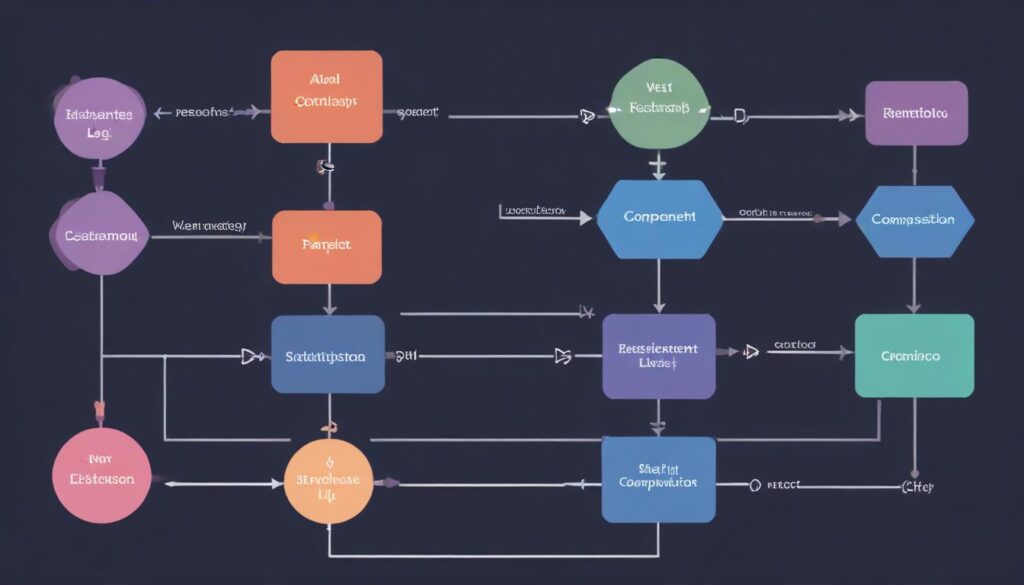
React revolutionized GUI development by introducing a declarative approach that abstracts direct DOM manipulation. Unlike earlier JavaScript frameworks focused on imperative updates, React prioritizes describing target UI states and letting the library handle transitions. This foundational philosophy addresses the core challenge of maintaining consistency across complex UIs, particularly when managing shared state and synchronization between components.
The Declarative Advantage: Why State Describes Over Updates Matter
At its core, React’s philosophy opposes the traditional imperative pattern of writing step-by-step instructions for UI changes. Instead of tracking DOM updates manually, developers declare desired states – what the UI should look like given specific data conditions. This paradigm shift enables more predictable behavior because the system automatically handles the transitional logic between states.
- Eliminates callback hell in complex user interactions
- Reduces debugging complexity by centralizing state definitions
- Simplifies component reuse through clear state dependencies
- Improves performance optimization through intelligent diffing algorithms
State Management As The Single Source of Truth
React’s component state architecture establishes a unidirectional data flow where UI behavior stems exclusively from component state values. This pattern ensures that all related UI elements reflect current data states, preventing common synchronization issues. When working with multiple components requiring shared information, proper state management becomes crucial for maintaining consistency without unnecessary re-renders.
- Avoid nested state lifting anti-patterns
- Implement context providers strategically for cross-component sharing
- Use memoized selectors for performance-critical data transformations
- Apply state partitioning principles across feature boundaries
Scalability Through Component Composition
Beyond individual component development, React’s component composition pattern scales naturally through hierarchical structures. Each component remains self-contained with its own state, while parent components coordinate state flow between subcomponents. This vertical integration allows large applications to maintain organization through modular components that encapsulate specific UI concerns.
- Structure UIs using container and presentational components
- Implement feature-based routing rather than view-centric
- Develop reusable custom hooks for cross-component functionality
- Maintain consistent state propagation patterns across features